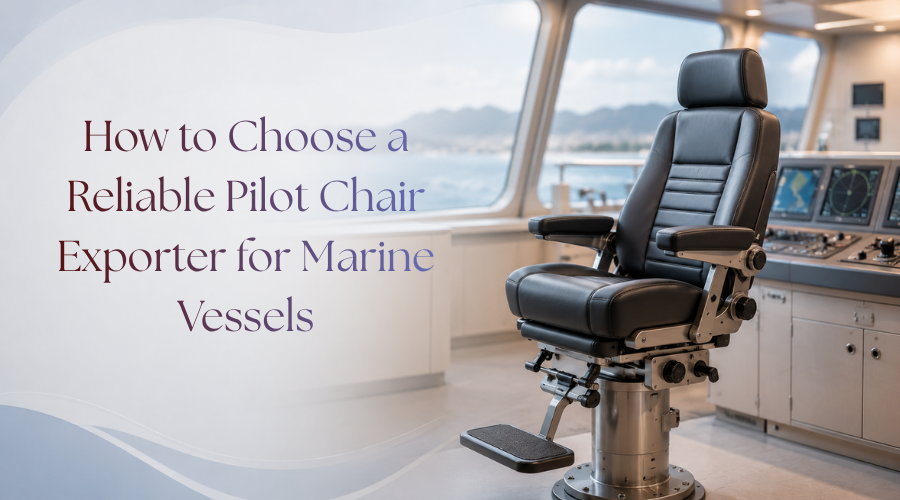
A pilot chair is not office furniture. It is a control station component that affects navigation safety. Yet many vessel manufacturers treat pilot chairs as an unimportant aspect of the onboard interior of the vessel. That leads to crew fatigue, failed inspections, and expensive mid-voyage breakdowns.
We know managing pilot chair procurement across multiple vessel classes is exhausting. Different flag states. Different crew body types. Different bridge layouts. Here is the data-backed system that fixes it.
Industry data shows that seating failures rank among the top five interior equipment failures on commercial vessels. Each delay cost the operator tens of thousands in rescheduled journeys and passenger compensation.
The good news is that a reliable supplier leaves a trail of evidence. Certificates. Test reports. Reference calls. This blog walks you through five steps to find that supplier. Follow these steps and you will never wonder whether your pilot chairs will last.
Poor lumbar support causes back pain within two hours of sitting Then there is the issue of limited seat adjustability that forces the pilot to lean sideways or slouch forward. Unstable bases create a constant distraction during rough seas. Each of these issues steals attention from navigation.
The International Maritime Organization documents these risks in Resolution MSC.452(99). A chair that fails ergonomic standards is a regulatory noncompliance issue. Not a comfort problem. Not a preference. A requirement.
A chair that fulfills its role as a helmsman chair can make a helmsman sit comfortably for a six-hour watch. Seat adjustments are effortless and can be done with one hand. The chair moves when needed and stays still when not. The crew member finishes the watch alert and is pain-free. That is the standard.
A broken pilot chair mid-voyage creates an emergency repair situation. No manufacturer wants that phone call from a shipowner. Yet this happens more often than the industry admits.
Data from class society records indicates that seating mechanism failures account for nearly fifteen percent of all bridge equipment breakdowns. The most common failure points are gas lifts, caster wheels, and adjustment levers. All preventable with proper supplier selection.
Understanding the cost of a bad chair is one thing. Knowing how to vet a ship helm seating supplier is another. In the rest of this guide we will tackle the second problem.
Quality Certificates Every Marine Pilot Chair Must Have
One thing to keep in mind is to never start price negotiations until you see documents. A reliable marine pilot chair manufacturer provides three specific certifications without hesitation.
First is the IMO MED Wheelmark with Module B and either Module D or F. The Wheelmark proves the chair meets European Union marine equipment requirements. Many other flag states accept it as well.
This certification is for bridge furniture and seating. This standard covers sight lines, control access, and stability requirements specific to navigation bridges.
This is for vibration and shock testing. According to IEC 60945 or an equivalent standard. A chair on a moving vessel experiences constant low-frequency vibration and sudden high-impact shocks. Testing proves the structure survives both.
"Type approval" means a third-party class society tested a production representative sample. The supplier cannot cherry-pick their best unit. "Self-certification" means the supplier tested their own product with their own methods.
A certificate from an unknown lab is not a certificate at all.
Recognized class societies include DNV, ABS, Lloyd's Register, Bureau Veritas, and RINA. Ask for the original type approval certificate number. Then verify it on the class society website before sending a purchase order. This takes ten minutes.
Imagine the peace of mind when you know that the installed forty pilot chairs across a new ferry fleet are all verifiable according to third-party certification. Every flag state inspection passes without questions.
Seat height adjustment allows different crew members to see over the bridge console. Armrest height and width adjustment supports elbows without blocking the controls. Backrest angle adjustment changes throughout a watch as posture shifts. Lumbar support position adjustment targets the lower spine's curve. Seat depth adjustment accommodates longer or shorter thighs. Headrest position adjustment supports the neck during head turns.
If a ship helm seating supplier offers fewer than five of these adjustments, keep looking.
Ask for the supplier's design range in millimeters. A vague answer like "fits most people" is not acceptable. A good answer looks like this. Seat height ranges from 480 to 620 millimeters. Backrest angle from 85 to 110 degrees. Armrest height from 180 to 300 millimeters from the seat surface.
The chair must remain stable under sudden vessel movement and shocks. This is proved through static testing. The static test confirms the chair holds weight without collapsing. Another type of testing is dynamic testing. This confirms the chair stays fixed and stable when the vessel rolls or pitches.
Ask for test reports showing stability during simulated conditions of fifteen degrees of roll and seven degrees of pitch. These numbers come from IMO guidance on bridge equipment stability.
A solidly tested chair in the event of encountering rough seas keeps the captain secure and comfortable. Controls remain within easy reach. The chair does not shift or wobble. That is what good ergonomics and proper testing deliver.
Marine environments destroy standard furniture through three specific failure points.
Upholstery breakdown from UV exposure happens quickly on bridges with large windows.
Corrosion on height-adjustment mechanisms makes the chair impossible to raise or lower.
Foam flattening from humidity and repeated compression leaves the crew sitting on a hard frame.
Specify stainless steel grade 316 for all exposed metal parts. Grade 304 rusts in salt air within two years. Grade 316 contains more molybdenum. It resists pitting corrosion even after years of salt exposure.
Marine-grade foam requires fire retardant additives that do not break down over time. Some suppliers use cheaper additives that leach out in humid conditions. Ask for foam certification to IMO A.652(16).
Upholstery must meet IMO A.652(16) for flame resistance and smoke toxicity. Marine-grade vinyl outlasts leather on a bridge by three to five years. Vinyl also cleans more easily. It resists salt staining. It does not crack from UV exposure.
Powder-coated mild steel fails within two years in a salt-air environment. The coating chips. Moisture reaches the steel. Rust spreads under the remaining coating. By year three, the chair base becomes structurally compromised.
Request a material specification sheet that lists every component from casters to stitching thread. A trustworthy marine pilot chair manufacturer provides this document without delay.
Quality control is not a one-time event. It is a process repeated with every production batch. Your marine pilot chair manufacturer should perform three specific tests on a regular basis.
Cyclical actuation testing simulates years of adjustment use. A machine raises, lowers, and tilts the chair thousands of times. This reveals weak points in gas lifts and mechanical linkages before chairs ship to your vessel.
Load testing applies dynamic impact to simulate a crew member sitting down quickly after a sudden vessel movement. Static weight ratings are not enough. The chair must absorb sudden force without cracking.
Flammability testing must be performed on upholstery and foam together, not separately. Two materials that pass individual tests can fail when combined. So the supplier must show the data of combined testing.
Batch traceability means every chair has a serial number linked to raw material lots. If a foam batch fails testing, the supplier knows exactly which chairs contain that foam.
Trust is not a quality control plan. Test reports are.
Traceability also matters for warranty claims. When a chair fails at sea, a traceability system tells you the production date. It tells you the material lots used. It tells you whether other chairs from the same batch are at risk. Without traceability, every failure becomes an isolated mystery.
The importance of traceability becomes relevant when you consider the following scenario. Suppose a caster fails on one chair after three years. You call the supplier with the serial number. They check their records and find that ten chairs from that same batch use the same caster lot. They ship replacement casters for all ten chairs before any others fail. That is traceability in action.
Marine manufacturers operate on tight production windows. A two-week delay in pilot chair delivery can delay an entire vessel launch. Ask your potential marine pilot chair manufacturer for their on-time delivery rate over the past twelve months. Request this number in writing. Then ask for two shipyard references from the past eighteen months. Call those references. Ask one simple question. Did the chairs arrive when promised?
Installation Guides
Installation problems often start before the chair reaches the vessel. A good supplier provides mounting templates. These paper or digital guides show exactly where bolt holes belong on the bridge deck.
3D Modeling Service
A good supplier provides 3D models for bridge integration. Your naval architecture team needs these models to check sight lines and control access. A supplier who only provides 2D drawings creates extra work for your team.
Spare Parts Availability
A great chair with no spare parts becomes a great problem.
Chairs need replacement casters after two to three years of use. Gas lifts fail after five to seven years. Upholstery wears out faster on high-use vessels like ferries. Ask for a spare parts price list and typical shipping times. If the supplier hesitates, that is a warning sign.
Add a line to your purchase contract requiring a ten-year spare parts commitment. This protects your client, the shipowner, from being stranded with an unrepairable chair.
Picture this outcome five years after delivery. The shipowner needs twelve replacement casters and two gas lifts. You call your supplier. They have the parts in stock. The parts arrive within one week. The chairs return to full function with minimal downtime. That is what reliability looks like over the long term.
Putting It All Together: A Five-Question Supplier Scorecard
Do not trust your memory. Use these five questions with every potential marine pilot chair manufacturer.
One. Show me your MED type approval certificate for this exact model. Not a similar model. Not an expired certificate. This exact model with a verifiable number.
Two. What is your tested adjustment range in millimeters for seat height, armrest height, and backrest angle? Request the actual numbers used in your anthropometric study.
Three. Provide material specifications for upholstery, foam, and metal. Include grade numbers for stainless steel and certification references for foam and fabric.
Four. Share your batch traceability procedure and recent test reports from the past six months. Look for cyclical actuation, load testing, and combined flammability results.
Five. Give me three shipyard references from the last eighteen months. Call each one. Ask about on-time delivery, documentation accuracy, and after-sales support.
Assign one point for each question answered with verifiable documentation. Partial answers receive no points. A supplier must score five out of five to qualify for your approved vendor list.
A perfect scorecard tells you that this supplier has done the hard work. They paid for the certifications. They documented their materials. They tested their batches, and they are ready for your business.
Your pilot-chair exporter decision affects every voyage a vessel makes. A reliable chair keeps the pilot focused on navigation. It lasts through years of salt air and constant adjustment.
Do not rush this decision. The sea will not rush to forgive a bad one.
You now have a five-step process. You have a five-question scorecard. You know what certificates to demand. You know what materials survive. You know how to test a supplier before you buy.
The difference between a good ship helm seating supplier and a bad one shows up not in the first month, but in the fifth year of service. One supplier delivers fifteen years of reliable operation. The other delivers a breakdown and an emergency phone call. Use the scorecard on your next pilot chair procurement. Get this step right. Everything else becomes easier.