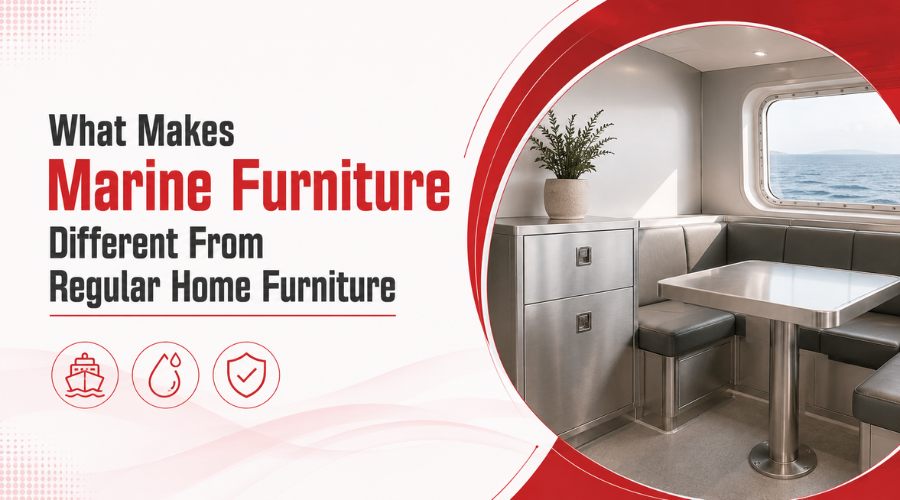
When you are outfitting a yacht, a commercial vessel, or a cruise ship, furniture is never just a finishing touch. It is a structural and safety decision. The wrong choice does not just look out of place. It fails. It rusts, warps, loosens, or worse—it becomes a fire hazard miles from the nearest port.
That is the reality every shipyard manager, naval interior contractor, and procurement officer faces. And it is exactly why marine furniture exists as a separate furniture category, built around three unavoidable challenges: constant moisture, relentless movement, and strict weight limits.
This guide breaks down what separates purpose-built marine furniture from standard home furniture and why working with a specialist marine furniture exporter is the only option that makes sense for serious vessel projects.
Think about what a marine vessel endures every single day. Salt-laden air. Condensation building inside cabins overnight. Engines vibrating through every surface. Decks pitching in open water. Then add decades of this—day after day, port after port.
Standard home furniture is not built for any of it. The wood swells. The metal pits. The joints loosen. What looks solid on a showroom floor becomes a liability at sea.
Marine furniture is engineered from the ground up for this environment. Every material choice, every joint, every fixing point is made with one question in mind: will this hold up after years of hard use at sea?
Moisture is the first enemy. It attacks from every direction on a vessel—ocean spray, condensation, and the simple humidity of life at sea. Standard furniture absorbs it. Marine furniture is crafted to reject it.
This means sealed surfaces, moisture-resistant core materials, and upholstery that does not trap water or encourage mold growth. Every component is selected to withstand continuous exposure without delaminating, swelling, or degrading.
For any trusted vessel furniture manufacturer building quality furniture, the goal is not just resistance to a splash of water. It is resistance to an environment that is perpetually damp. That difference changes everything about how marine furniture is designed and constructed.
Here is something that rarely comes up when specifying furniture on land: gravity is reliable onshore. At sea, it is not.
A vessel rolls. It pitches. Engine vibration travels through the hull and into every fitting on board. Furniture that is simply placed in a room will shift, slide, and eventually become dangerous. A heavy locker that tips in rough seas is not a minor inconvenience—it is a safety incident.
Marine furniture is designed with built-in secure fixing components and mechanisms. Floor anchors, wall-mount brackets, recessed fittings, and anti-vibration joints are part of the design. Whether you are fitting out crew cabins on a commercial ship or a luxury stateroom on a superyacht, every piece is made to stay exactly where it is placed.
Vessel interiors do not follow standard room dimensions. The walls are curvy, and corridors are narrow. Engine rooms eat into the cabin area. The irregular geometry of a ship's interior is one of the most demanding fit-out challenges in any construction discipline.
Standard-sized home furniture simply does not work in these spaces. It leaves awkward gaps, reduces usable floor area, and looks mismatched and out of place.
Purpose-built marine furniture is designed for precise fit within tight and irregular layouts. Custom dimensions, modular configurations, and recessed hardware all allow furniture to work with the geometry of the vessel rather than against it. The result is efficient use of every centimeter of cabin space. This is something that matters enormously on commercial vessels and cruise ships where every square meter has a function.
Weight is a constant factor that needs to be considered when designing ship furniture. Every kilogram added to the interior affects stability, fuel efficiency, and load capacity. This is especially true on commercial ships and offshore platforms where operational economics are tight.
Marine furniture is built using materials that deliver structural strength without adding unnecessary mass. 316 or 316L stainless steel are the most common grades used for marine applications due to the inclusion of molybdenum in their composition. Grade 316 stainless steel contains 16 percent chromium, 10 percent nickel, and 2 percent molybdenum—and that molybdenum significantly reduces corrosion from the salt in seawater and de-icing chemicals.
Paired with UV-resistant vinyl upholstery and lightweight structural panels, 316 stainless steel delivers a furniture construction that is genuinely tough without being heavy. You get longevity and load discipline in the same specification.
On land, if there is a fire, people evacuate outdoors. At sea, that option does not exist. A ship is a confined space with limited escape routes and no immediate external help—which is why the IMO mandates that all materials on board must possess extremely high flame retardancy, ensuring they do not ignite easily or burn very slowly, buying valuable time for evacuation.
Upholstered furniture and beds installed on passenger-carrying marine vessels must comply with guidelines published by the International Maritime Organization to meet Chapter II-2 of SOLAS 1974, which covers fire protection, fire detection, and fire extinction.
Every kind of vessel furniture from wall and ceiling panels, flooring systems, insulation materials, textiles, and furniture components must comply with strict fire performance criteria, including non-combustibility, low flame spread, and limited smoke and toxic gas emissions.
The Wheelmark confirms that a product complies with the IMO Fire Test Procedures (FTP Code) and is approved for use on vessels operating in international waters—and for shipyards and shipowners, this certification acts as a technical passport, ensuring acceptance by flag administrations and classification societies worldwide.
If you are procuring furniture for a passenger vessel or offshore platform, Wheelmark-certified products are not optional. The use of uncertified materials can lead to serious project delays, rework costs, or rejection at the delivery stage. That is a risk no shipyard can afford.
Saltwater is aggressive. It does not just corrode; it attacks the surface. Saltwater causes a specific type of damage called pitting corrosion, where small, deep holes form on the metal's surface, which can quickly lead to failure.
316 stainless steel has molybdenum as an extra ingredient that reinforces its protective layer, making it much stronger against chloride attack—which is why 316 holds up so well against the corrosive effects of seawater, sea spray, and salt-heavy air.
UV damage is the second long-term threat, particularly for outdoor deck areas on yachts and cruise ships. Standard upholstery fades, cracks, and degrades under prolonged sun exposure. UV-resistant vinyl retains its color, structural integrity, and surface finish across years of direct sunlight—making it the right specification for any exterior or semi-exposed marine seating application.
Together, 316 stainless steel and UV-resistant vinyl form a material pairing that is designed to last the full service life of the vessel, not just a few seasons.
A crew cabin on a commercial vessel is used every day, around the clock, by rotating personnel. A passenger stateroom on a cruise ship turns over multiple times per voyage. Offshore platform accommodation operates continuously for months at a stretch.
None of this resembles how home furniture is used. Standard residential furniture is designed for light, intermittent use. Marine furniture is built for relentless daily demand—from lockers that are opened and shut dozens of times a day to berths that must hold their structural integrity through years of continuous occupancy.
Durability is not a selling point here. It is the minimum requirement.
Maintenance at sea is constrained. You work with what is on board. There are no furniture showrooms nearby, no replacement parts in the next town, and no time for lengthy maintenance procedures during an active voyage.
Marine furniture is designed with this reality in mind. Surfaces are smooth, sealed, and easy to wipe down. Hardware is accessible. Upholstery materials repel staining and resist the cleaning agents used in commercial marine environments. When something does need attention, it can be dealt with using tools and materials that are already on board.
This keeps vessels operational and interiors looking professional—whether you are receiving guests on a superyacht or managing crew welfare on a commercial ship.
As a specialist vessel furniture manufacturer, Minsunmarine has a comprehensive range of furniture built to perform across all vessel types and operational categories.
Beds and Berths—Designed for compact cabin configurations with secure fixing systems and SOLAS-compliant bedding support
Lockers—Heavy-duty, corrosion-resistant storage solutions for crew and passenger cabins
Wardrobes—Space-efficient, custom-dimensioned units built to fit irregular bulkhead layouts
Desks and Workstations—Functional surfaces built to withstand vibration and daily operational use
Seating—From crew mess seating to luxury yacht saloon chairs, upholstered in UV-resistant vinyl
Stainless Steel Furniture—Full 316 stainless steel furniture systems for galleys, utility areas, offshore platforms, and deck applications
Commercial ships and cargo vessels
Passenger vessels and ferry interiors
Cruise ships and river cruise vessels
Offshore platforms and drillships
The sea does not forgive shortcuts. Moisture, movement, weight, fire risk, and years of relentless daily use—these are not challenges that standard furniture is designed to handle. Marine furniture is a specialist category for a reason, and the difference between the right specification and the wrong one shows up quickly once a vessel is in service.
Whether you are fitting out a luxury superyacht, a commercial cargo ship, a cruise vessel, or an offshore platform, you need a marine furniture exporter that understands the demands of each environment and supplies furniture built to meet them.
Get in touch with our team today to discuss your vessel fit-out requirements and request a project-specific supply proposal.
Q: Does all marine furniture need to be SOLAS certified?
Upholstered furniture and bedding on passenger-carrying vessels must comply with SOLAS Chapter II-2 fire protection requirements. Products intended for EU-flagged vessels must carry Wheelmark certification. If you are procuring for offshore platforms or commercial ships, your flag state authority and classification society will define the specific compliance requirements for your project.
Q: Why is 316 stainless steel specified for marine furniture rather than standard stainless steel?
The relatively high concentration of molybdenum (2.0 to 2.5%) present in 316 stainless steel helps stop saltwater from causing pitting or crevice corrosion—the type of damage that standard 304-grade stainless steel cannot adequately resist. For furniture used in galleys, utility areas, and deck applications, 316 is the reliable, long-term specification.
Q: Can marine furniture be customized to fit non-standard cabin dimensions?
Yes. Custom fitment is a core part of what a specialist marine furniture exporter provides. Cabins on commercial vessels, offshore platforms, and yachts rarely conform to standard room dimensions. Furniture is designed and manufactured to the exact measurements of your interior drawings, including curved bulkheads, low deckhead clearances, and irregular floor plans.